
Platypus vs. Perry the Platypus: Same Brand, Different Names—Why the Illusion of Choice Works.

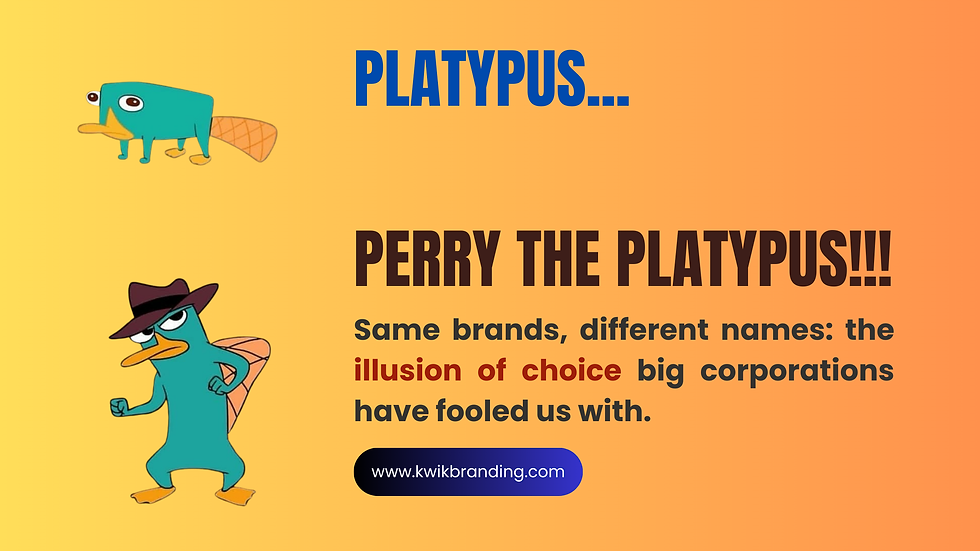
Most “choices” in modern markets are cosmetic. When everything looks different but behaves the same, belief erodes. The brands and leaders that win don’t multiply options—they repeat meaning.
📖 Contents
The Platypus in the Aisle
As kids, many of us watched Phineas and Ferb without questioning the logic. A platypus puts on a fedora and suddenly becomes someone else. Same animal. Same DNA. New name. New authority.
Funny? Yes. But also uncomfortably accurate.
Because in today’s business world, we’re surrounded by Perrys. Same parent company. Same supply chain. Same leadership philosophy. Different logos. Different tone of voice. Different “brands.” The market is flooded with options that look like choice but behave like clones.
Walk into any store—or scroll any marketplace—and the shelves feel infinite. Colors change. Prices shift. Promises evolve. But beneath the surface, a quieter truth exists: many of these “choices” trace back to the same handful of parent companies.
Different brands. Same owners. Same incentives.
This isn’t an accident. It’s a system. And it works—until it doesn’t.
What “Choice” Really Means Today
Choice, in theory, means having multiple independent options. In reality, modern choice often means brand segmentation under one roof.
Today, large corporations don’t just compete—they acquire. Buying smaller brands reduces risk, absorbs demand, and creates internal competition that looks external. On the shelf, it feels like freedom. On the balance sheet, it’s consolidation.
For consumers, this creates the illusion of control.For businesses and leaders, it creates a deeper problem: when everything sounds different but means the same, nothing stands out.
How the Illusion Is Built
1. Same Product, Different Personality
A premium shampoo and a budget alternative may share suppliers, formulas, and factories—yet feel worlds apart. One speaks in aspiration. The other in value. Both serve the same parent company.
Branding doesn’t just differentiate price; it segments identity.
2. Emotional Branding Over Structural Difference
Corporations sell identity before utility. Natural. Ethical. Luxury. Minimal.These cues trigger belonging, not scrutiny. We don’t ask who owns this—we ask who does this make me.
That’s why the illusion holds.
3. Shelf Space as Silent Strategy
When one corporation owns five brands in a category, it doesn’t just win customers—it crowds out alternatives. Independent brands struggle not because they lack quality, but because visibility itself becomes a luxury.
The Psychology That Keeps Us Loyal
Humans don’t choose rationally as often as we think.
We choose what feels familiar.
Repetition builds trust. Recognition lowers effort. Price anchoring reshapes value. When one brand feels “expensive,” another from the same owner suddenly feels reasonable—even if both benefit the same bottom line.
The result isn’t deception. It’s cognitive relief.
Advertisement strengthens this, colors, fonts, and images are carefully chosen to suggest uniqueness. Even similar products look unrelated at first glance. Advertising repetition builds credibility. When different brands repeat similar messages, consumers rarely suspect shared ownership.
Consumers believe they’re choosing freely, but the underlying options are often controlled by the same players – same platypus with different hats.
Why This Model Is Starting to Crack
People aren’t overwhelmed by too many options, they’re fatigued by artificial ones. As consolidation deepens, difference starts to feel staged. New logos read like costume changes. Rebrands feel cosmetic. Consumers can sense when variety is performative rather than real.
That awareness changes behavior. Choice stops feeling empowering and starts feeling manipulative. Instead of comparing, people disengage. Trust thins. Skepticism rises.
In this environment, monopoly-driven abundance no longer works the way it once did. Owning the shelf, flooding the feed, and multiplying brand names can create visibility but not belief. And without belief, control over choice quietly loses its power.
The Perry Principle: Why Clarity Beats Variety
Perry the Platypus doesn’t change species.He changes context.
The fedora doesn’t make him smarter—it signals intent.
That’s the lesson most brands miss.
Identity Is Not Visual—It’s Behavioral
Great brands don’t ask, “How many versions can we create?”They ask, “What do we stand for when no one is watching?”
Without that anchor, every new brand feels like a disguise.
Familiarity Builds Trust Faster Than Novelty
Perry works because he’s predictable. Same entrance. Same mission. Same competence.
In business, trust compounds when your message sounds the same across platforms, teams, and time. That only happens when leadership is aligned—not just creatively, but philosophically.
When Voice Scales, Belief Scales
The strongest leaders don’t speak more. Their thinking travels further.
They build systems that translate intent into consistent language. Not louder. Clearer. When that voice fractures, organizations sound like multiple brands arguing with each other. When it aligns, they feel inevitable.
Consistency Is the Real Differentiator
Anyone can sound smart once. Few can sound the same for years.
In a world obsessed with reinvention, repetition of meaning becomes rare—and therefore powerful.
What This Means for Consumers—and Leaders
For consumers, real choice begins with awareness:
Read labels
Research parent companies
Support independent brands where possible
For leaders, the lesson cuts deeper.
Leadership isn’t just decision-making. It’s meaning-making.
The most effective CEOs and CXOs don’t chase visibility. They chase understanding. They treat communication as a strategic asset. They speak in principles, not slogans. They repeat ideas without diluting them.
Because they know this truth:
You don’t win by offering more choices.You win by making one idea unmistakably clear.
When the Illusion Fades
Perry didn’t win because he had a better disguise.He won because he was firm in his principles and unwavering in his identity when it mattered. When the hat went on, Dr. Doofenshmirtz didn’t just recognize him — he knew what was coming.
In markets filled with the same brands, different names, clarity is the only thing people remember.
The illusion of choice fades.But a clear voice—repeated with intent—doesn’t.


Comments